
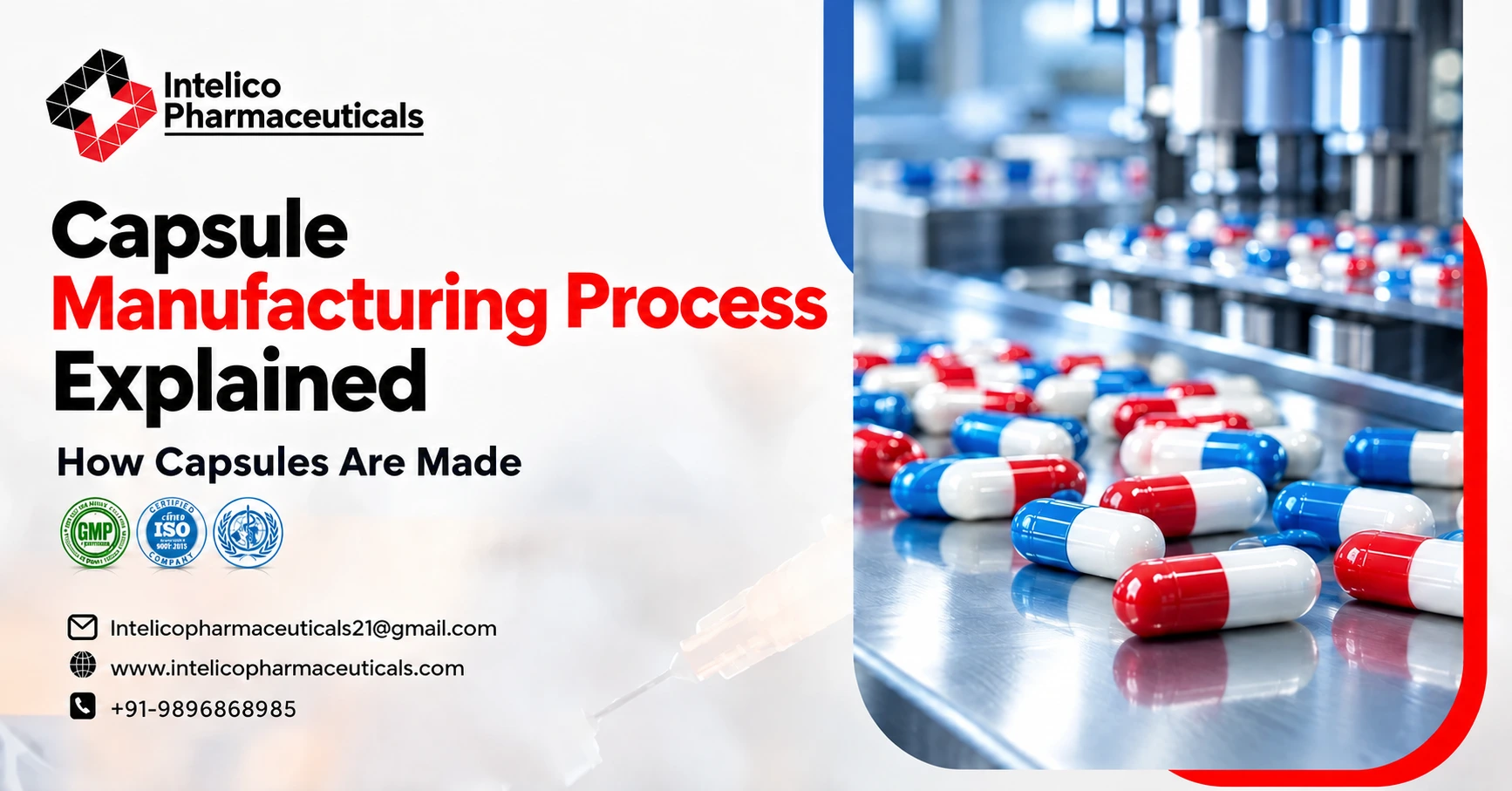
The capsule manufacturing process takes various raw materials and changes them into precise doses of oral medication. In other words, the packaging process requires the use of machines which will enclose the granules, powders, or liquids inside a gelatin or HPMC shell. Moreover, the formulation units in India produce more than 150 billion capsule units per year to satisfy growing healthcare needs. Understanding the complete capsule making process helps ensure high quality and batch uniformity. Besides, establishing a standard line of capsule production requires an initial set-up cost in the range of ₹25 lakh to ₹1.5 crore.
Furthermore, accuracy of dosing allows for uniform drug delivery and improved bioavailability without causing any gastrointestinal irritation. Therefore, knowing each step of the process makes it possible to follow strict standards of the pharmacopeias. Ultimately, the following explanation provides details on the machinery, quality control measures, and industrial procedures involved in capsule making process.
How Are Capsules Manufactured in the Capsule Manufacturing Process?
Capsule production requires maintaining a certain level of humidity and temperature in the sterile cleanroom environment. In addition, the process involves automatic encapsulation machines able to manufacture as many as 150,000 capsules per hour. Moreover, the raw materials undergo size selection and moisture content testing before being added to the main production cycle.
As a result, the exact dosage weight prevents any variations in the therapeutic effect in large batches. Learning how capsules are made allows facility managers to streamline production lines effectively. Moreover, high-speed optical sorters identify whether the capsule shell is good enough not to send defective units for packaging.
- Empty shell loading and orientation take place automatically in the high-speed rotary machines.
- The precise mechanical pins separate empty capsule caps from body segments.
- The dosing tamping pins compress powders of active formulation into compact plugs.
- The mechanical jointers connect the filled capsule body securely to the cap.
- The polishing units remove any traces of residual dust before the weight inspection of units takes place online.
What Are the Main Steps of Capsule Manufacturing?
Following a standardized capsule manufacturing process flow chart ensures every batch meets regulatory standards.
1. Preparation of Gelatin Solution
First, the manufacturer dissolves raw gelatin or HPMC polymer in demineralized water at a temperature of 60°C in a jacketed stainless steel vessel costing approximately ₹5 lakh. After that, the approved colorants and plasticizers are added to achieve the desired viscosity values for shell formation.
2. Shell Formation and Drying
Then, automated dipping pins dip into the prepared solution of the polymer. The uniform thickness of the film is achieved on all pins before sending them to climate-controlled drying chambers where moisture content is reduced to the level of 13-16%.
3. Formulation Powder Blending
At the same time, the active pharmaceutical ingredients are mixed with excipients in the high-shear planetary blender costing approximately ₹3.5 lakh. Consequently, correct powder distribution prevents any weight variations in the process of high-speed filling. This critical stage in the overall capsule making process guarantees proper active ingredient distribution.
4. High-Speed Encapsulation Process
After that, the dosator machines separate the halves of empty shells and inject the doses of formulation precisely into body segments. Therefore, the modern dosing systems provide a weight tolerance of ±1 percent.
5. Polishing and De-Dusting
Finally, rotary dedusting drums clean the shells’ surface with the help of air jets and micro-fiber brushes. Consequently, the finished capsules get polished before entering the final phase of blister packaging.
How Is the Quality of the Capsules Controlled During the Production?
In order to ensure that the quality standards of WHO-GMP are met in the manufacturing of all products, there is a strict procedure of in-process testing for all batches. Optimizing the capsule making process at every stage helps maintain this high standard of quality control.
| Testing Parameter | Standard Acceptance Limit | Instrument | Cost Range (INR) |
|---|---|---|---|
| Weight Variation Test | ±7.5% for units <300 mg | Analytical Digital Balance | ₹45,000 – ₹1.2 lakh |
| Disintegration Time | Less than 15 minutes | Disintegration Tester | ₹85,000 – ₹2.5 lakh |
| Moisture Content | 12.5% to 16.0% range | Karl Fischer Titrator | ₹1.8 lakh – ₹4.0 lakh |
| Dissolution Profile | >85% release in 30 minutes | USP Dissolution Apparatus | ₹3.5 lakh – ₹8.0 lakh |
| Locking Length | Specified mm per size | Digital Vernier Caliper | ₹12,000 – ₹35,000 |
Why Should You Choose Intelico Pharmaceuticals for Capsule Manufacturing?
1. WHO-GMP Certified Manufacturing
The reliable capsule manufacturers in India, Intelico Pharmaceuticals, have ultra-modern production facilities with advanced climate controls. Consequently, the production environment guarantees sterile conditions that prevent any contamination during the entire encapsulation batch cycle.
2. High Production Capacity
Additionally, our automated high-speed machinery produces over 50 lakh capsules per day. Therefore, the pharmaceutical brands receive timely delivery schedules without any violations of strict quality parameters or batch consistency.
3. Cost-Efficiency
Moreover, our contract manufacturing services start with competitive batch rates of around ₹1.2 lakh per batch. Thus, the client brands maximize their margins in obtaining superior dosage formulations.
4. Testing Laboratory
Besides, our in-house testing laboratories operate on high-performance liquid chromatography systems. Thus, all batches are analyzed for purity and correct drug concentration before dispatching.
5. Versatile Shell Options
Finally, we offer diverse size specifications starting with Size 00 to Size 4 in vegetarian HPMC and hard gelatin formulations. Consequently, the partner companies can customize the shell colors, branding prints and formulation profile.
The Bottom Line
Therefore, knowing how capsules are made shows the technical accuracy of modern oral solid dosage production. Mastering every stage of the capsule production process ensures optimal yield and efficiency.
Moreover, the implementation of the optimized capsule manufacturing process flow chart guarantees seamless batch production with zero weight variations.
Executing a seamless capsule making process builds long-term product trust. Consequently, partnering with reputable capsule manufacturers provides pharmaceutical companies with a unique competitive advantage. Intelico Pharmaceuticals is the industry leader in providing fully certified, cost-efficient contract manufacturing solutions to your brand.
Frequently Asked Questions
What is the ideal moisture content of the hard gelatin capsule shells?
The required moisture content of the hard gelatin capsules should be between 13% and 16%. Therefore, a low moisture level makes shells brittle, while excessive moisture makes them softer and unstable.
How does a dosator encapsulation machine differ from a tamping pin machine?
The difference between the two is in the way the powder is inserted into the capsule. Specifically, the dosator uses a vacuum tube to pick up powder, while a tamping pin machine uses the mechanical pins to compress powder in the plug form.
What causes weight variation during capsule filling operations?
Such issues as poor flowability of powder, improper granule size distribution, and inconsistent powder bed height in the hopper cause weight variations during filling.
Why Do Manufacturers Prefer HPMC Capsules Over Traditional Gelatin Capsules?
The HPMC capsules are made from vegetable cellulose. Therefore, they have a lower moisture content and greater thermal stability, contain no animal byproducts and are less prone to cross-linking with active formulations.
What is the disintegration time limit for hard capsules?
According to the pharmacopeia standards, the hard gelatin capsules should disintegrate completely in warm water or artificial gastric fluid within 15 minutes without any core residue left.
How Are Softgel Capsules Manufactured Differently from Hard Shell Capsules?
Unlike hard capsules, softgel capsules are produced with simultaneous formation, filling and sealing in a rotary die process using liquid or suspension fill.
What Environmental Conditions Are Required in the Encapsulation Cleanroom?
An encapsulation cleanroom needs the relative humidity between 35%-45% and temperature at 20°C-22°C to avoid softening of shells or formation of powder clumps.
How do Lock-Ring Mechanisms Avoid Capsule Opening During Transport?
The indented locking ring present on the cap and body parts snap together firmly, creating a hermetic seal preventing dust leakage and tampering.
What Optical Sorting Systems Inspect Finished Capsules?
The high-speed vision camera scans passing capsules at 360° angles and air-jets those units with surface dents, color variations, loose caps or pinholes to the reject bin.
What is the Shelf Life of Properly Stored Hard Gelatin Capsules?
Unformulated hard gelatin shells can maintain full structural stability for up to five years when stored in airtight containers at temperatures below 25°C and relative humidity below 60%.